
2024 Colorado 14er Hiking Use Estimates
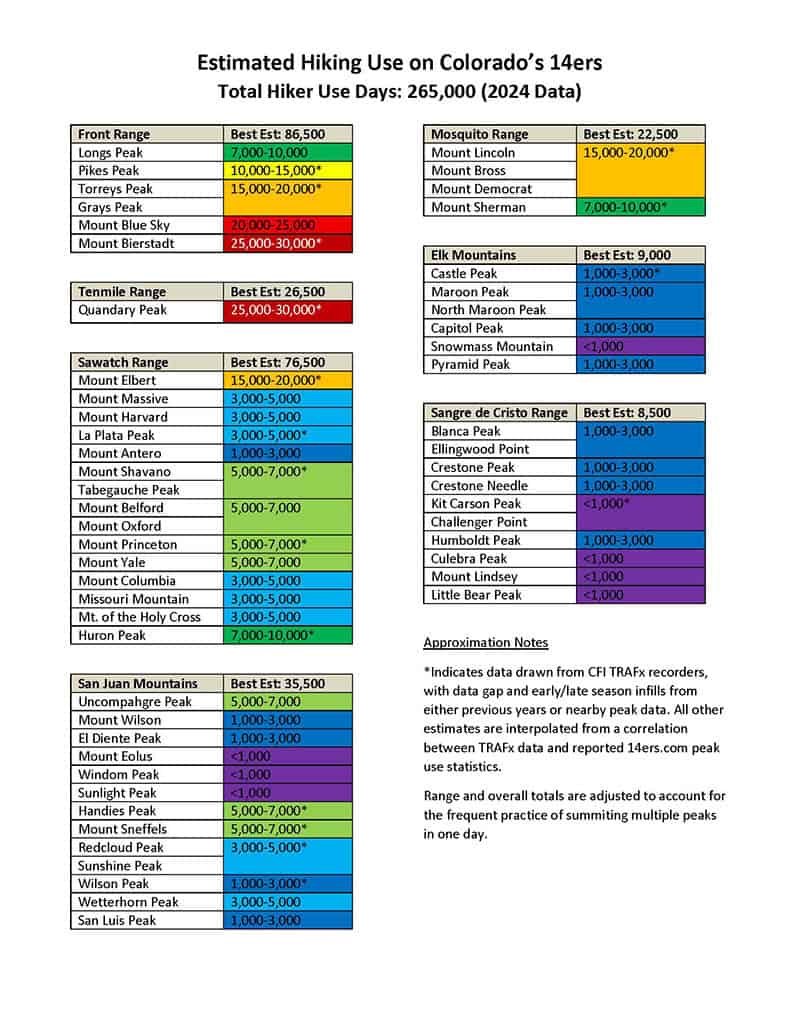
Colorado Fourteeners Initiative (CFI) has been monitoring hiking use on Colorado’s 14,000-foot peaks using infrared trail counters since 2014. The program has continually expanded to cover additional locations and provide more accurate estimates of statewide hiking use. CFI is excited to share the latest edition of its report, which shows that the number of people hiking Colorado’s fourteeners increase slightly from 260,000 in 2023 to 265,000 in 2024. This represents a 1.9 percent bump from 2023’s estimate.
The reopening of the Decalibron Loop near Alma and a revised calculation for Mount Blue Sky were the largest factors increasing estimated hiking use, while declines at several top locations largely offset these higher levels. Fourteener hiking use peaked during the 2020 pandemic summer at 415,000 hiker days but has steadily returned to the mean since then.
CFI’s estimate of hiking use suggests a statewide economic impact of $71.9 million directly attributable to hiking fourteeners in 2024, based on past economic expenditure studies performed by Colorado State University economists John Loomis and Catherine Keske. Their 2009 study found that climbers of Quandary Peak near Breckenridge spent an average of $271.17 per day on gasoline, food, lodging, equipment, and other retail purchases. Given the decade-old data, these figures are likely understated in today’s economic context.
[i] Loomis, John and Catherine Keske, “Did the Great Recession Reduce Visitor Spending and Willingness to Pay for Nature-Based Recreation? Evidence from 2006 and 2009,” Contemporary Economic Policy, Vol. 30, No. 2, April 2012, pp. 238-246.
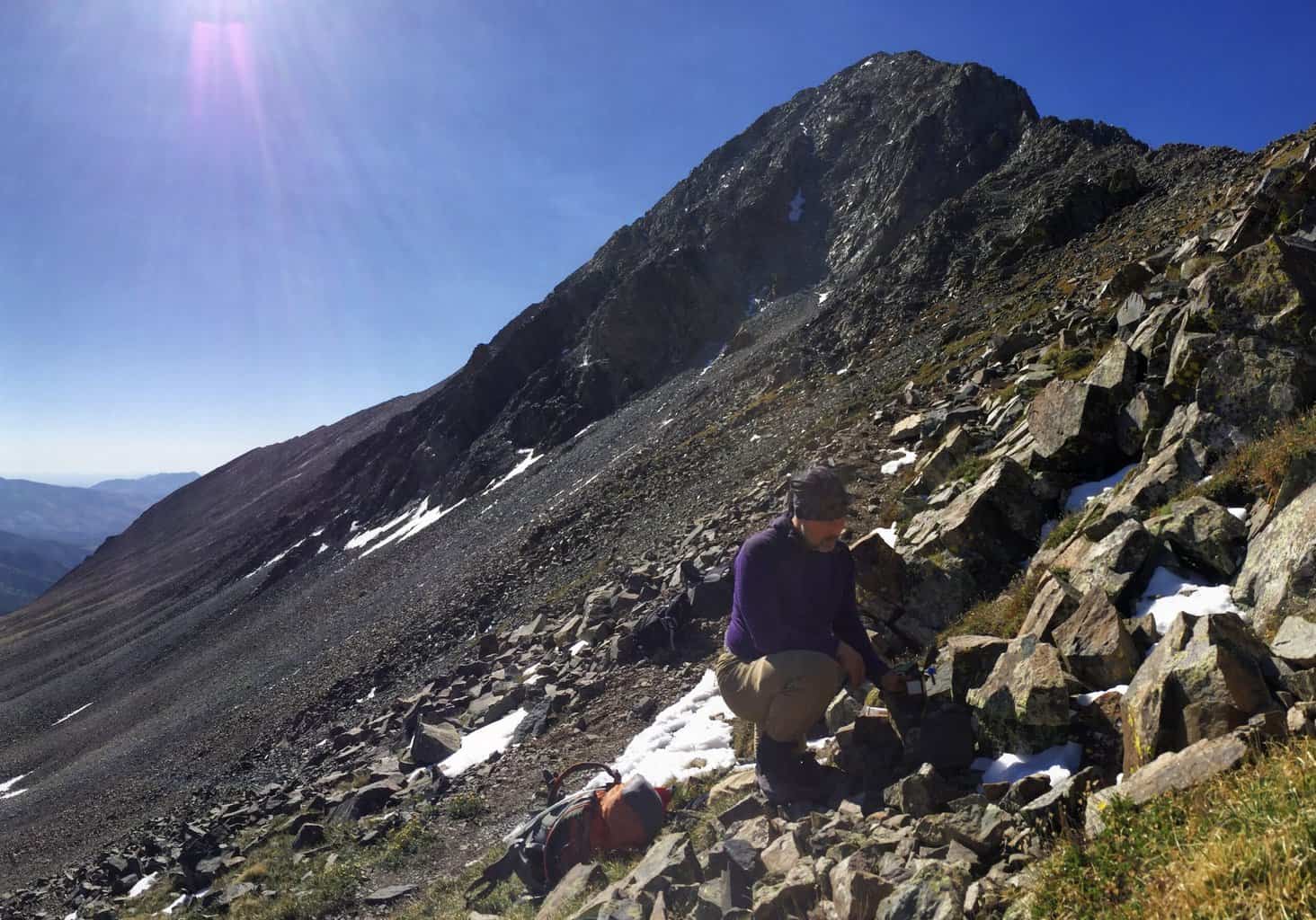
Lloyd Athearn installing an infrared trail counter just below the summit of Mount Lindsey.
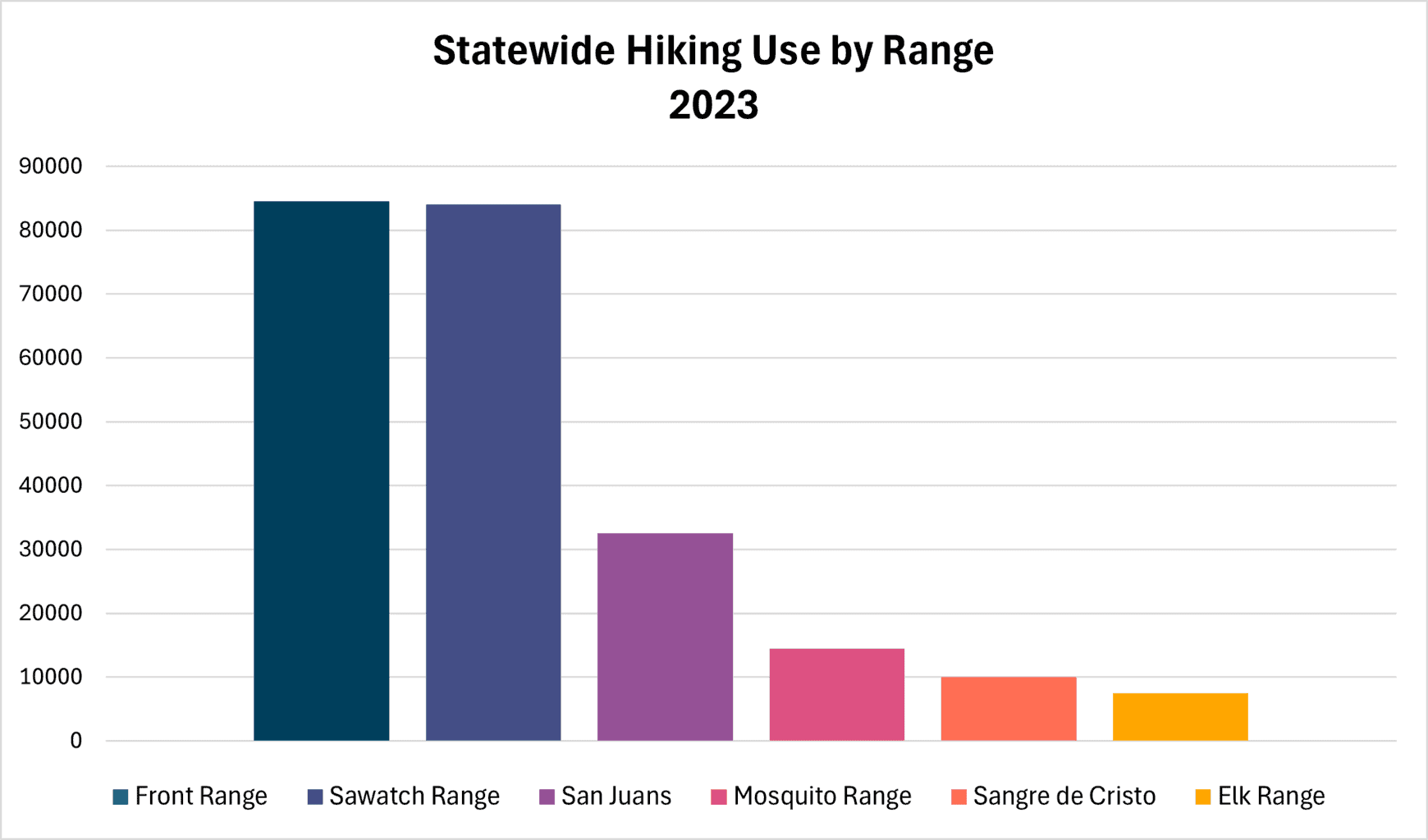
Compared to 2023, hiking use in 2024 fell in three mountain ranges: Sawatch Range (-7500 days, -8.9 percent), Sangre de Cristo Range (-1500 days, -15 percent), and the Tenmile Range (-500 days, -1.9 percent). Hiking use was up in in four ranges: Mosquito Range (+8000 days, +55 percent), San Juan Mountains (+3000, +9.2 percent), Front Range (+2000 days, 2.4 percent), and the Elk Mountains (+1500 days, +20 percent).
CFI’s most recent report culminates 10 years of data collection from up to 23 infrared trail counters placed adjacent to summit hiking trails, covering 22 peaks statewide. In 2024, data was gathered from May 26 to October 5. To fill in any gaps due to missing data, a linear model incorporating week number, day of the week, holidays, and use levels on other similar peaks was used, a method proven to be statistically accurate. Additionally, hiking use projections for peaks without trail counters were determined using a trend line based on crowdsourced “14er checklists” submitted by over 25,900 individual hikers on 14ers.com.
CFI uses “hiker use days” to represent one person hiking one peak on a given day, offering a comprehensive view of hiking activity on Colorado’s 14ers. By understanding hiking use levels, seasonal dispersal, and trends over time, CFI can better assess the impact of hiking on the fragile alpine environments of Colorado’s 14ers, guiding efforts to preserve these unique landscapes.
In 2020, Matt Albritton, a Yale undergrad studying computer science and engineering, helped further refine CFI’s data modeling program that was originally developed in 2016. Matt cleaned and rewrote the program’s code and created an updated version using Python. The program helps fill in gaps in the data due to obscured counter sensors or periods in the early or late season when the counter is not in place. This model incorporates the week of the season, day of the week, holidays, and similar peaks with data to fill in missing data. See an example below of the predicted vs. measured data.
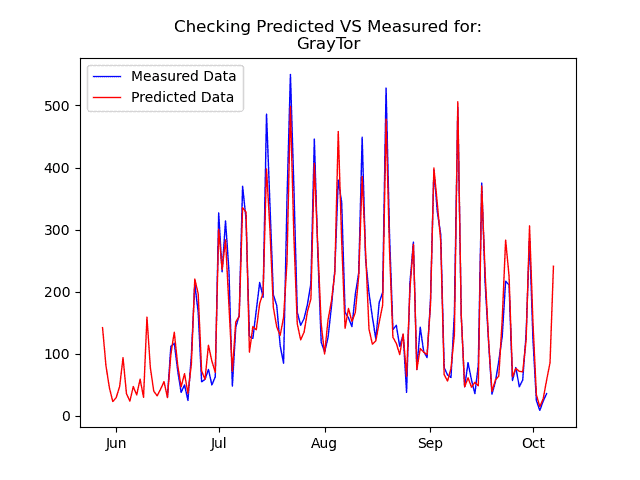
CFI uses a multi-factor modeling program to predict hiking use levels when we do not have a counter on a given peak or when there are data gaps. The program’s modeled data for use levels on Grays and Torreys (red line) largely mirror what was actually recorded by our counter (blue line). The program’s predictions are helpful to fill in the early season gap when CFI’s trail counter was not yet in the field.
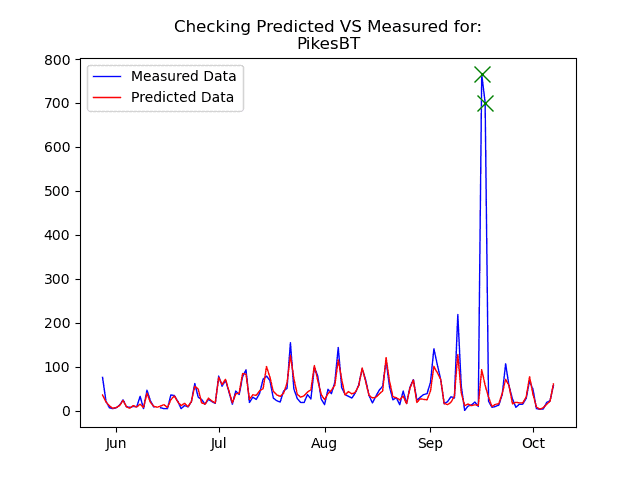
In this chart, we again see that CFI’s program has accurately predicted hiking use on Pikes Peak’s Barr Trail (red line). However, the program did not anticipate the increased hiking use which occurred in September during the Pikes Peak Ascent and Marathon. CFI flags these outliers (green X) in our modeling program to ensure that estimates for other peaks do not include these spikes in use.
CFI has long been interested in the amount of hiking use these popular peaks receive. Colorado’s 14ers are among the most sought-after mountain peaks in the country. They also possess some of the most fragile alpine landscapes. Hiking use is confined into a very short four-month climbing season when the mountains are largely free of snow. Natural resource impacts in the fragile alpine tundra environment, stemming from the lack of properly designed and constructed summit trails on the 14ers, led to CFI’s founding back in 1994.
Special thanks goes out to CFI’s summer CLIMB interns Emily Barnes (2016), Claire Gomba (2017), Nick Dahl (2018), Jackson Burton (2019), Matt Albritton (2020), and Farah Stack (2021) who helped place trail counters, analyze data, and refine CFI’s estimates.
Additional Links:
2023 14er Hiking Use Estimates
2022 14er Hiking Use Estimates
2021 14er Hiking Use Estimates
2020 14er Hiking Use Estimates
2019 14er Hiking Use Estimates